Ride included
Half day with Hmong village
309 steps or cable car
- ClimbStairs or cable car
- Temple1 hour
- Reviews714
Guides
Language
Currency
Find open datesfrom $25 · cancel without payingChecklist to tick off
List of 9 items
Tick each item when it is done. Your place is saved on this device.
0 / 9 ready
You are good to go. Pick your evening for the golden chedi, and the rest is settled.
Hold a seatThe step count by source, what the tourism authority says about the funicular and the tram, the fee and hours it lists, and how to choose between walking and riding.
Editorial team, doisutheptour.top · Updated November 16, 2026 · A 6 min read
In brief
Ask how many Doi Suthep steps lead to the temple and the answer depends on where you read it. The Chiang Mai provincial page says many devout Buddhists walk 290 steps up to the hilltop, after the option of driving up to the higher platform.1 TAT's newsroom says a staircase of over 300 steps starts at the parking area.2 Tour listings that describe the stairs give 306 in several records and 309 in others.
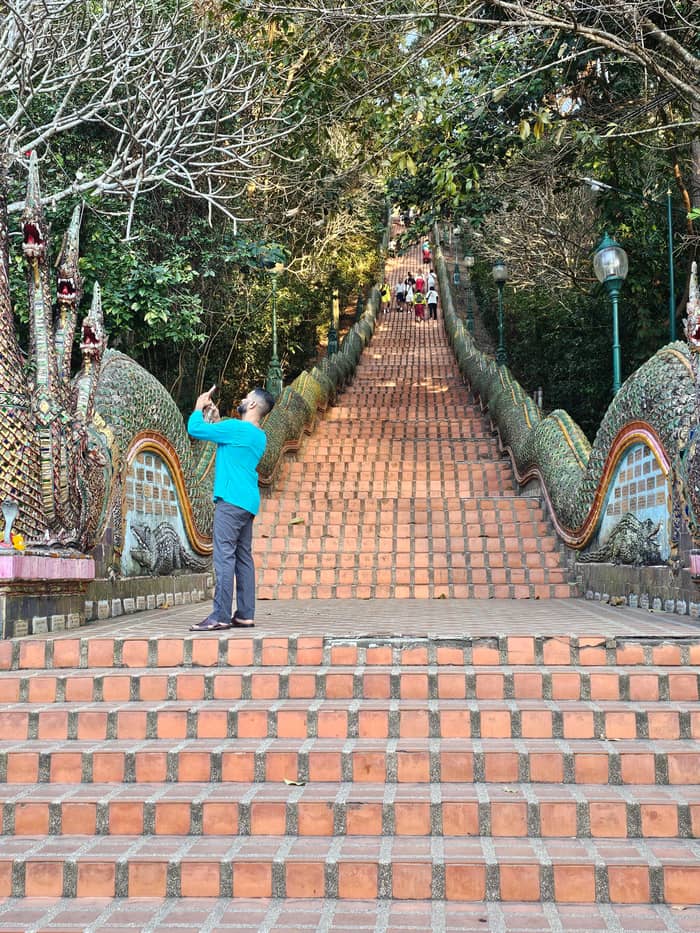
The spread is small and the cause is probably where each count begins, whether at the foot of the stairs or at the entrance terrace, though no source says so. For planning, take the middle of the range and expect a long flight of stone steps that you will feel in the legs. The stairs have their own name, too: one listing calls them the 306-step Naga staircase, and TAT says seven-headed serpent statues line the way up.6 When a tour guide tells you a number, it is probably one of these.
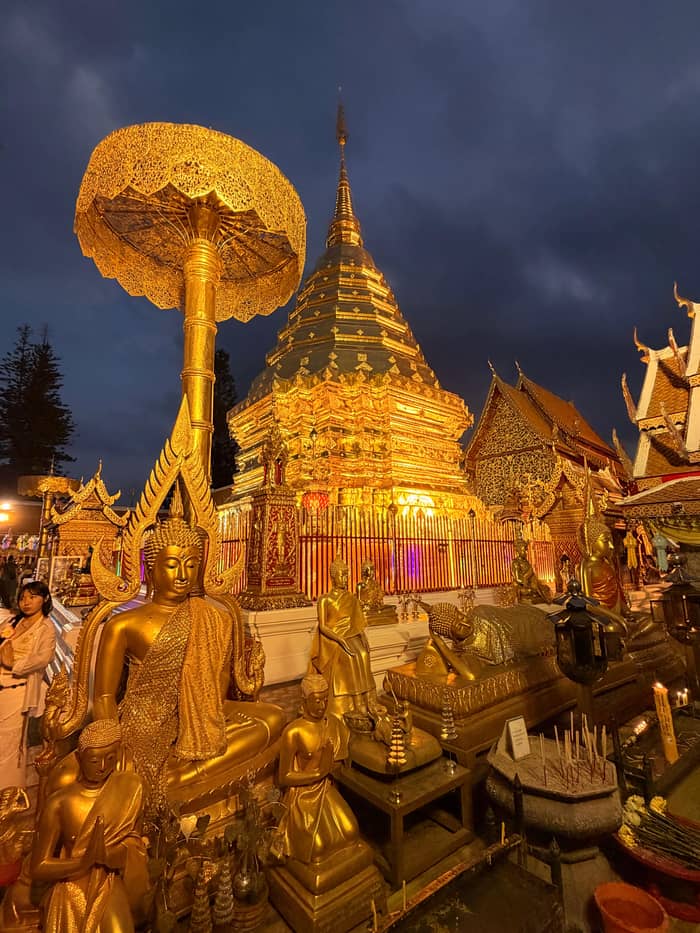
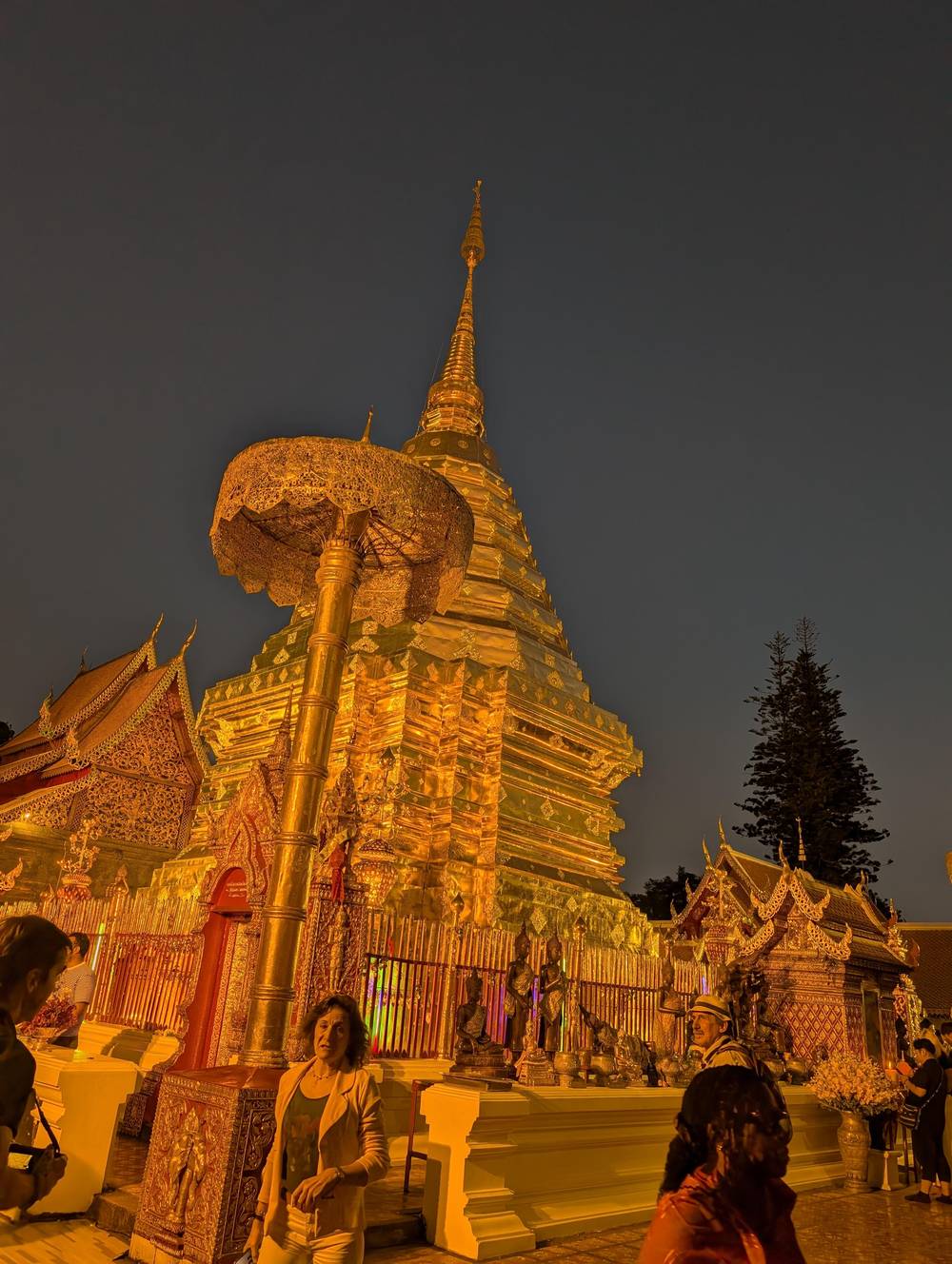
The count matters less than the setting. The stairs end at the golden chedi, which TAT describes as 24 metres high, with murals of the Buddha's life to see, and the temple stands 1,056 metres above sea level.2,7 The province tells visitors to continue to the terrace after prayer for panoramic views of Chiang Mai and its surroundings.8 Climbing the stairs is a part of the visit, not a chore to get past.
Ways up
| Way up | What it is | Time window | Cost |
|---|---|---|---|
| On foot | Stairs lined with serpent statues6 | Temple 6.00 am - 5.00 pm5 | No ticket named |
| Funicular cable car | Named by TAT from the parking area2 | Not stated | Not stated |
| Electric tram | Listed on TAT's temple page3 | 6.00 am-6.00 pm3 | THB 50 foreigners4 |
| Tour with the ride | Stairs or the included cable car | 4 hours | from $34 |
| Driving | Up to the higher platform1 | Not stated | Parking at the top |
Fees come from an archived TAT page; check prices at the station. Tour fares are from prices.4
A lift exists, and TAT mentions it twice in different words. In its article on Chiang Mai's wonders, TAT describes more than 300 steps up from the parking area and a funicular cable car as the other route.2 Its temple page, as archived on 26 September 2023, lists the ways to reach the temple: the seven-headed serpent stairs, or an electric tram that runs from 6.00 am to 6.00 pm.3 For the Doi Suthep temple cable car, those are the only official lines we could open.
The tram page also gives a fee, and it separates visitors by nationality. It lists THB 50 for foreigners and THB 20 for Thais, written as 50 THB and 20 THB.4 That page is an archived copy, so the price shown at the station is the figure that counts. Take small notes in baht to the ticket window and keep the ticket, because the provincial hours and the tram hours stop at different times.
Tours settle the fare in different ways. One half-day listing describes the climb as 309 steps or the included cable car, so the ride is not an extra charge on that booking. Other listings describe a choice of 306 steps or a tram ride, and a third calls it the 306-step Naga staircase or the cable car. If you plan to ride, ask the operator whether the lift is in the price before you book.
Visitors who ask about a Doi Suthep temple elevator for elderly relatives are really asking about the funicular and the tram. TAT names both, and nothing we could open says how many people each carries, how long the queue runs, or whether a wheelchair rolls on.2,3 So the honest answer is that a lift is part of the temple's access, and that the details of using it are for the ticket window and your operator to confirm on the day.
Be realistic about what the lift does and does not remove. It spares the stairs from the parking area, and the hall is still entered barefoot, with racks for shoes outside.9 A relative who tires quickly can ride up and still has to walk the last stretch on foot to the hall, so build in rests. Bring a thin layer, because the mountain air is cooler than the city.12
Some listings carry accessibility labels, and they are worth reading closely. A hike tour is marked wheelchair accessible, and a van transfer to the temple and Wat Pha Lat carries the same label. Those labels describe the booking and the vehicle, not every stair on the mountain, so ask the operator exactly what the label means for the temple steps before you rely on it, and describe your companion's needs plainly when you do.
Quick check
Match your party to a row and read what the sources suggest.
If I walk easily and want the pilgrim climb
Take the stairs
Seven-headed serpent statues line the stairs up to the golden chedi.6
If It is a hot afternoon in April
Take the lift
The TMD names April the hottest month of the whole year around Upper Thailand.10
If A parent who tires on stairs
Plan the lift
TAT names a funicular cable car and an electric tram as the alternative.2,3
If I arrive close to the end of the day
Mind the clock
If It rained all week
Lift and dry shoes
The park counts 139 rainy days a year, so wet steps are a real risk.11
Tours that include the lift
Ride included
309 steps or cable car
Unguided
Naga staircase or cable car
This site's tour
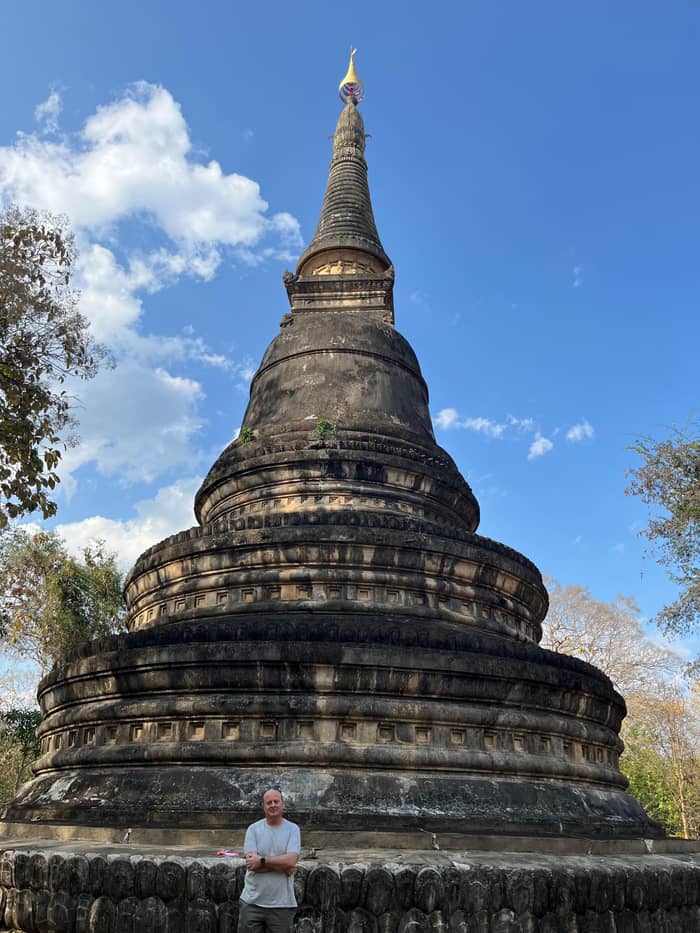
Wat Umong, then the temple
The mountain is cooler than the city, which helps on a long climb. On the mountain the coldest months are December to February, with the park recording an average low of 4 to 5 degrees Celsius.12 TAT's cool season stretches from November to February.16 A cool morning makes the stairs easy, and a layer is welcome when you stop at the top.
Heat and rain are the enemies of the stairs. The Thai Meteorological Department describes April as the hottest and stickiest month of the whole year around Upper Thailand, and says the thunderstorms of March are brief and often arrive with strong gusts.10,17 The park counts 139 rainy days a year and annual rainfall of 1,350 to 2,500 millimeters, so a wet day on a stone staircase is always possible.11 In the rains, the lift is an easier choice than slick steps.
Haze belongs in the plan as well. The dry season brings smoke. In 2019 TAT suggested N95 masks and the Pollution Control Department's Air4Thai app for parts of the north where the air was unhealthy, and named forest fires, scrub burning and traffic as the main sources.15,18 Look at the air before a pre-dawn start. Then check the clock too: the province gives the temple 6.00 am - 5.00 pm, while the tram page runs until 6.00 pm, so be on the stairs before the earlier closing.5,3
Price your group
Type your party size and each tour's fare is totalled for you.
Compare 3 alternatives
Type your party size and each tour's fare is totalled for you.
≈
View≈
View≈
ViewConverted at the ECB reference rate, from-prices as listed by GetYourGuide. The precise amount is shown when you book.
The climb in order
Parking
The parking area is where the stairs and the lift begin.2
The choice
Climb on foot, or take the funicular instead.2
The stairs
Seven-headed serpent statues line the way up.6
At the top
Shoes stay on the racks; the hall is barefoot.9
The chedi
The chedi is described as 24 metres high.2
The terrace
After prayer, the terrace looks over Chiang Mai.8
The stairs are the pilgrim's way, and for most healthy walkers they are the better choice. They are also where the serpent statues are, and TAT lists a festival, Tiaw Khuen Doi, built around the journey up the hill.6,19 Go up on foot, take your time at the landings, and use the lift on the way down if your knees ask for it. Many visitors alternate, which suits families with different paces.
Choose the lift when heat, a child in a carrier, a bad knee or a short schedule make the stairs a barrier. A tour with the ride included, such as the half-day listing that describes 309 steps or the included cable car, takes the decision out of your hands. A tour that gives you an hour at the temple leaves little slack for a slow climb, so book more time at the temple if you plan to walk.
If you arrive on your own, the road helps too. The province notes that a car can reach the higher platform, and TAT lists small buses from Chiang Mai University between 5.0 am and 5.0 pm.1,20 Whichever way you go up, cover your shoulders and knees for the hall, and carry shoes you can slip off quickly at the racks.13,9 Then the only question left is whether you walk down too.
Video
Daily Dish Diaries on YouTube · Nothing is fetched until you hit play.
Walking up the seven-headed serpent stairs. It is also a great spot to take pictures.
FAQ
An archived TAT page lists THB 50 for foreigners and THB 20 for Thais; confirm at the ticket window.4
A car can reach the higher platform, the province notes; the chedi is a climb beyond it.1
Entering a temple is done barefoot, with shoe racks outside, as TAT explains.9
A listing calls them the 306-step Naga staircase, and TAT says serpent statues line the stairs.6
Sources
Planning a trip up Doi Suthep? Ask a real person here.